
The term ‘public record’ refers to documentation of any kind (including, but not limited to, written records, photographs, and video) that is not considered to be confidential or private. Public records are available to almost anyone, hence the oft-used phrase ‘it’s a matter of public record’.
Typically, public records consist of data concerning the conduct of government, as well as limited personal information, such as births, marriages, deaths, and interactions with certain government agencies.
But what about police body-cam footage? Is footage of private citizens taken by police officers ‘a matter of public record’, or is it strictly confidential?
In the UK, footage taken by a police body-worn camera (BWC) is subject to the terms of the Data Protection Act 2018 (AKA ‘GDPR’). According to law, detailed footage of a person is considered to be ‘personal information’, and is thus protected. This means that, while a citizen does not have the power to request that a police officer cease filming them, they do have a legal right to access and view any footage which they are the subject of.
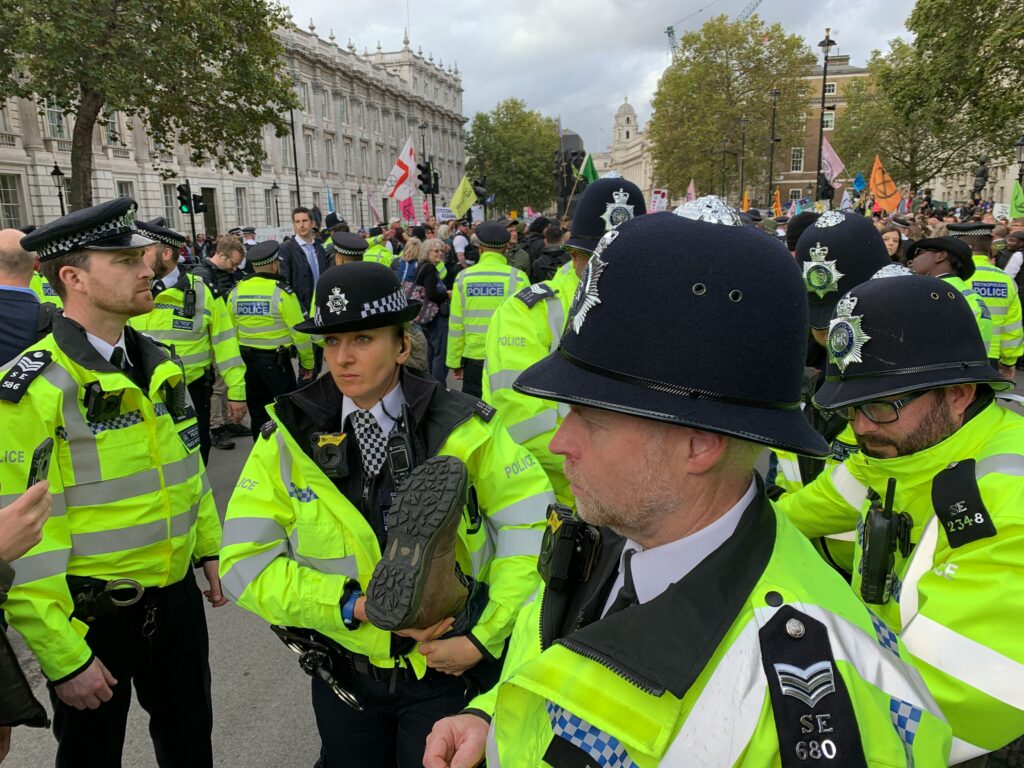
To access police footage, a ‘Right To Access’ request must be filed with the relevant constabulary. Once this is successful, footage concerning the subject may be viewed at a previously agreed-upon time and date.
After being uploaded to secure servers at the end of an officer’s shift, police BWC footage is automatically deleted after 31 days, in accordance with the Data Protection Act (which decrees that information is kept for no longer than necessary). The only exception to this rule involves instances wherein footage is evidence of a crime, and as such forms part of an ongoing investigation or legal proceedings.
Police are also legally required to inform members of the public that they are being filmed. However, they are not required to seek consent before or during filming. It is also understood that emergency situations may require officers to activate the camera without informing the subject that they have done so.
Police officers have to demonstrate a reason for activating their BWCs, and are not permitted to simply use them on a whim. Police BWCs are only to be used during interactions with the public, or to gather evidence of a suspected criminal incident.
UK police are considered the ‘data controllers’ of all police BWC footage. As such, they ‘own it’, although in reality this amounts to their being legally responsible for the storage and use of any footage they take (again, according to GDPR regulations). They therefore have a legal duty to store all footage safely, to keep it private, and share it only with those that have a legal right to view it.
In summary, police BWC footage does not form part of the public record, as it is only accessible by the police and the subject(s) of the footage. A member of the public cannot access police information that does not pertain to them, and therefore police information is not a matter of public record.